

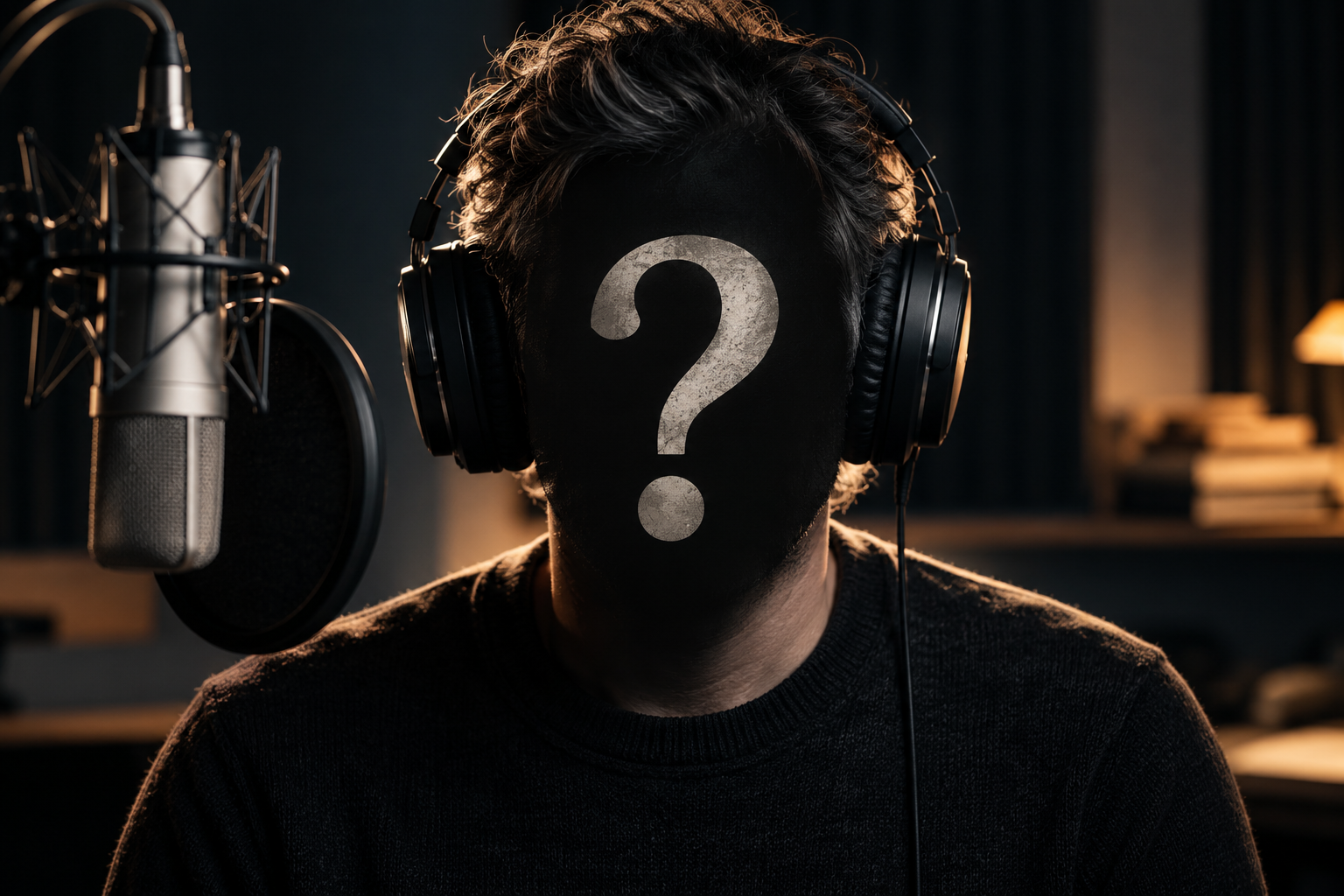
If you’re wondering how to find your narrative voice as an audiobook narrator, start by asking a deceptively simple question: who is the narrator?
When it comes to audiobook narration, most voice actors spend a lot of time thinking about characters.
What do they sound like? How old are they? Where are they from? What is their personality? What is their character arc?
And if you’re narrating fiction, particularly a book with a large cast of characters, there can be a lot to keep track of. We think about voices, accents, mannerisms, and attitudes, and try to make each character distinctive enough that the listener can follow who is speaking.
For an example of this more character-focused approach, take a look at this article from Voices.com.
But there is another character in the book that is very easy to overlook:
The narrator.
The Narrator is Also a Character
This is something I didn’t really think about when I first started narrating. It took me a while to realise that finding that voice is part of the narrator’s job too.
With books written in the first person, it is fairly obvious. Somebody is telling us the story, and that somebody may also be one of the characters in it.
If the text says:
I was late that morning, and I was rushing for the bus.
there is a very obvious person behind those words.
They have a voice, a personality. They have a particular point of view. If they are also a character in the story, then it is fairly natural to think about what they sound like and how they would tell their own story.
But what about third-person narration?
It is tempting to think of the third-person narrator as simply being you, just the voice that reads the words on the page.
I think it can be much more useful to think of them as a character too.
Not necessarily a character who actually appears in the story. They may never be seen, spoken to, or even acknowledged by anyone in the book. But they are still the person telling the listener what is happening, and that means they have a point of view.
The narrator’s voice
Whenever I approach a new piece of writing, one of the things I now try to establish fairly early on is the voice of the person telling it:
Who is this narrator?
What kind of voice suits this story?
What is the narrative telling me about the “character” of the storyteller?
Do they have a particular accent, age, or style?
Are they formal or conversational? Warm or detached? Serious or playful?
Are they emotionally involved in what they are telling us?
Sometimes the answers will be obvious from the writing. Sometimes they won’t. If it’s an audition piece with little supporting information, then you often have to make your best guess. Personally, I often try to seek out further info on a book, if it’s available, in order to answer some of these questions if they are not obvious from the audition excerpt itself.
And I’m not suggesting that you should invent a completely separate “character voice” for the narrator. In many books, that would be completely wrong. It may be that the narrator simply sounds like a natural version of yourself. But, even then, I think it is useful to have made that decision consciously.
There is a difference between deciding that the narrator is essentially neutral and simply not thinking about the narrator at all.
The narrator is a character in the listener’s mind
There is another reason I find this useful.
Think about the experience of listening to someone tell you a story. Even if you know nothing about them, you naturally form some kind of impression of the person doing the telling:
Are they excited by what they are telling you?
Amused?
Frightened?
Are they detached and analytical?
Are they the sort of person who enjoys telling stories?
The same thing happens with an audiobook. The narrator becomes a character in the mind of the listener, simply because they are the person telling them the story. That doesn’t mean the listener consciously thinks, ‘Ah, here is the narrator character.‘ It is much more subtle than that.
But there is somebody on the other side of the microphone, and the listener will inevitably get some sense of who that person is. I think that is worth using.
First person makes it obvious
First-person narration is probably the easiest example.
If the narrator is also the protagonist, then you obviously have a character voice to consider. But there is another subtlety here: The person telling the story isn’t necessarily the same person they were when the events actually happened.
Imagine somebody telling you about something that happened to them twenty years ago. The person speaking to you now has twenty years of hindsight. They may understand things that they didn’t understand at the time. Or they may be amused by their younger self, or embarrassed, or angry.
All of that potentially influences the way the story is told. So, even with first-person narration, there can be more going on than simply finding a voice for the protagonist.
And that, in a sense, is the beginning of finding your own narrative voice: working out who you are in relation to the story you are telling.
You’re finding the voice of the person telling the story.
Third person doesn’t mean neutral
Third-person narration can make this much less obvious. The narrator may appear to be an invisible presence, simply describing what happens. Third person tells us how the story is grammatically written. It doesn’t necessarily tell us whose point of view we are experiencing.
This is where I think it is particularly useful for a narrator to understand the difference between an omniscient narrator and a limited point of view.
An omniscient narrator, in the traditional sense, knows everything.
They can tell us what different characters are thinking, tell us what happened years ago, and what is happening somewhere else at the same time. Crucially, they can tell us what any character is thinking or feeling.
They can move around the story almost without restriction.
A limited narrator is different.
The book may still be written in the third person, but we are experiencing events primarily through the point of view of one particular character. Oftentimes, this is known as third-person POV (Point of View) writing. The information, impressions, thoughts, and feelings that the narrator expresses are limited to the POV of a particular character.
In fact, you may often encounter various combinations of the limited and omniscient narrator within the same book. It’s also possible to have limited POV narration for not just one character, but two or even several. There are no hard and fast rules!
What matters is to be aware of these shifts in perspective and to think about how they can be best presented via your narrative voice.
The more clearly you understand that relationship, the more confidently you can make decisions about how the story should sound.
Whose point of view are we with?
Imagine a scene involving a character called Emma Carter. The book is written in third person:
Emma walked slowly towards the door.
You’re not necessarily supposed to read that literally in Emma’s character voice. You’re still the narrator. But if the scene is being told from Emma’s point of view, then you’re experiencing the scene with Emma.
If the previous paragraph described how Emma felt about the possible contents of the room, her trepidation, uncertainty, a looming sense of creepiness… then that seemingly simple line, ‘Emma walked slowly towards the door,’ can be the perfect opportunity to convey that sense of dread and hesitance that puts us squarely in Emma’s head without the narrator having to ‘become’ or ‘sound like’ Emma.
You’re not suddenly becoming Emma; you’re telling the story from Emma’s point of view. That’s an important distinction. The narrator’s voice remains the narrator’s voice, but the narrator is now looking at the world through Emma’s eyes.
Once you start thinking about it that way, it becomes much easier to put a little bit of emotion into narrative passages without turning them into character dialogue.
But…
Don’t overact it
There is an obvious danger here.
Once we start talking about putting emotion into narration, it is very easy to go too far. I’m not suggesting you should perform every descriptive sentence like a dramatic monologue. Quite the opposite.
The effect I’m talking about can be very small: A slight change in energy; A little more tension; A touch of warmth; A subtle change in pace; A word given slightly more weight…
Sometimes it’s barely perceptible, but those little things can help the listener feel that there is somebody behind the words.
This is particularly important when you’re reading descriptive passages.
Dialogue gives you an obvious opportunity to perform a character. The character is speaking, so you can give them a voice, whereas narrative is different. There may be long stretches where nobody is actually speaking. That’s where thinking about the narrator can help.
Imagine you’re telling the story to someone
One of the simplest exercises I’ve found useful is to stop thinking about the microphone for a moment.
Imagine that you’re sitting in a room with one person and telling them the story.
Rather than reading it to them, think of it as telling it to them.
Who are you?
What is your relationship with them?
How do you feel about the story you’re telling?
If something frightening has just happened, are you going to tell them about it in exactly the same way as you would describe an ordinary walk down the street? Probably not.
You don’t necessarily have to perform the fear. But the fact that you know the scene is frightening might subtly affect the way you tell it, and that’s often enough.
I think this is one of the reasons that good narration should still feel natural. Despite all the mental preparation that might have gone into deciding how to voice ‘the narrator’, in the end, you don’t want to sound like you’re trying to “sound like a narrator”.
You’re simply telling a story in a way that brings it to life.
The narrator can carry emotion without becoming a character
This is perhaps the part that took me the longest to appreciate.
When you’re starting out, there can be a tendency to think that you have two modes:
Character mode — I’m acting.
Narrator mode — I’m reading.
But I don’t think it really works that way. The narrator can be emotionally present without becoming another character in the conventional sense. You can be the storyteller without stealing the scene from the characters. In fact, I think that is often the sweet spot.
The narrator is there, but doesn’t draw attention to themselves. They give the listener enough emotional information to understand how the scene feels, while still allowing the story and its characters to remain the focus.
This is particularly important when you’re working with limited point of view.
If we’re seeing a scene through Emma’s eyes, for example, then the narration should reflect what Emma is experiencing. But, it shouldn’t suddenly sound as though Emma herself has started narrating the book. That distinction can be very subtle. And, as with so many things in narration, subtlety is often the key.
A useful exercise for new narrators
If you’re new to audiobook narration, try doing this the next time you start a new book.
Before you worry too much about performance, read a few chapters simply to understand the story.
Then ask yourself:
Who is telling me this story?
It sounds like a simple question, but it can be surprisingly revealing. It may tell you more about the voice you need to adopt than any instruction to “sound like a narrator” ever could.
You might make a few notes.
- What kind of voice suits this story?
- What does the writing tell me about the character of the storyteller?
- Are they formal or conversational?
- Warm or detached?
- Serious or playful?
- Do they have a particular age or style?
- Are they emotionally involved in what they’re telling me?
- Is the narrator omniscient?
- Or are we experiencing the story through a particular character’s point of view?
- If it’s limited POV, whose point of view are we with in each scene?
You don’t necessarily need definitive answers to all of these questions. The point is to start thinking about them. Then try reading a passage twice. The first time, read it as you normally would. The second time, put one simple idea in your head:
I am somebody telling this story to somebody else.
Then listen back.
You may be surprised by how much difference such a small change in thinking can make.
One more character to think about
When I first started narrating, I spent a lot of time thinking about the characters in a book.
I still do, but I think there is a tendency, particularly when you’re starting out, to treat everything outside of dialogue as something that simply needs to be “read”. The character speaks; we perform the character. The character stops speaking, and we go back to being the neutral narrator.
But perhaps there isn’t really such a thing as a completely neutral narrator.
Even if the narrator is deliberately restrained, that restraint is itself a choice. The narrator has a relationship with the story; they have a relationship with the listener. They know some things; they may not know other things. They may be looking at the story from above, or they may be standing beside one particular character and experiencing it with them. If we give a little thought to who that person is, I think we can breathe life into the parts of a book that might otherwise become rather flat.
So when you pick up your next manuscript, spend some time thinking about the characters:
Think about their voices, about their motivations, their arcs.
But before you press record, ask yourself one more question:
Who is the narrator?
Once you’ve started to think about the narrator as a distinct presence rather than simply a neutral reading voice, it can be useful to listen to how different approaches work in practice. You can hear examples of different approaches to audiobook narration and narrative style in my audiobook samples.